


You’ve built the skills. You’ve put in the hours. But in a market where every candidate claims to know Python, data analysis, or cloud infrastructure, the question isn’t whether you have technical skills. It’s whether you can prove it in a way employers actually trust.
Technical skills are now table stakes for most professional roles. What separates candidates is verification: the ability to show (not just say) that you’ve mastered something specific. That shift is reshaping how employers hire and how professionals advance, and it’s worth understanding before your next job application or performance review.
What are technical skills?
Technical skills are the specific, learnable abilities needed to perform defined tasks, particularly those involving technology, data, systems, or specialized tools. They’re measurable, teachable, and verifiable in a way that broader competencies aren’t.
The definition has expanded significantly. Decades ago, technical skills belonged almost exclusively to engineers, IT professionals, and mathematicians. Today, a customer service rep needs to navigate CRM software. A marketer needs to read a dashboard. An HR manager needs to work with HRIS platforms. Technical ability has become a baseline expectation across departments, not just a specialist distinction.
Some of the most in-demand technical skills across industries right now:
- Data analysis and data visualization
- Project management tools (Asana, Monday.com, Jira)
- Cloud computing and SaaS platform administration
- Programming languages (Python, SQL, JavaScript)
- Cybersecurity fundamentals
- AI tools and prompt engineering
- Technical writing and documentation
Why employers are looking beyond the resume
Listing ‘Python’ or ‘SQL’ on a resume is easy. Verifying it is a different problem and employers know it.
According to Accredible’s 2025 State of Credentialing report, 84% of HR leaders say they’ve encountered misrepresented skills on resumes. That number helps explain a parallel one: 91% of those same HR leaders now actively look for digital credentials when reviewing candidates, and 86% say a credential showing specific technical skills makes them more likely to arrange an interview.
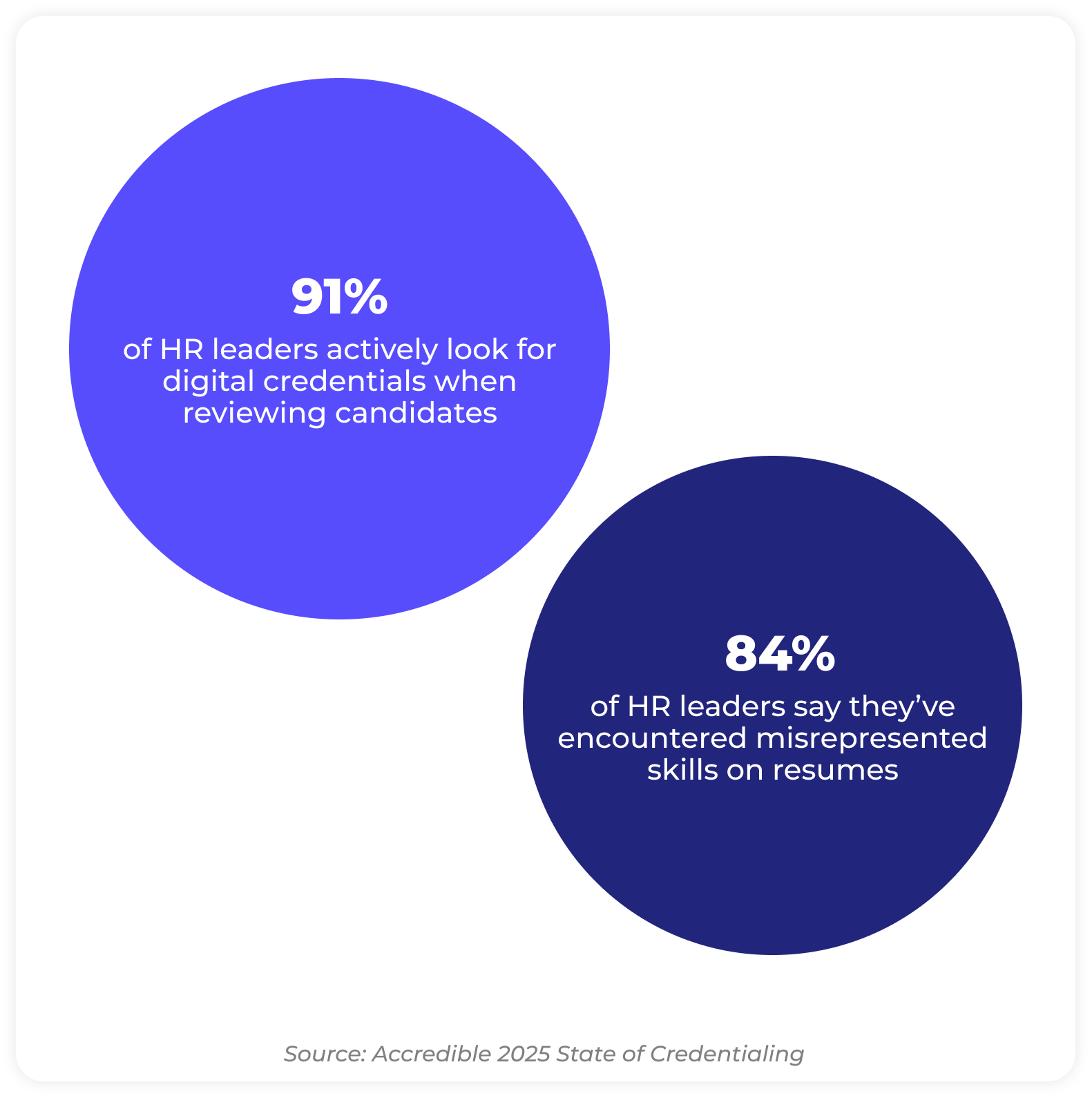
The gap this creates is significant. Employers want verified proof. Most candidates are still submitting unverified claims. Closing that gap by earning credentials that demonstrate your skills, not just name them, is where the career advantage actually lives.
How technical skills drive career advancement
The career case for technical skills goes beyond getting hired. Once you’re in a role, technical proficiency is one of the clearest signals you can send to leadership that you’re ready for more responsibility.
Consider a marketing team where two people have equivalent communication skills. One knows how to pull reports from a CRM, run attribution analysis, and set up automation workflows. The other doesn’t. The decision about who moves into a more senior role writes itself.
Technical skills compound. When you can operate a tool your team relies on, you save colleagues time, and that visibility accumulates. You become the person others defer to, which is how individuals build influence before they have the title to match it.
There’s also a direct productivity argument. When you know how a tool works, you can complete work faster, catch errors sooner, and take on adjacent tasks that might otherwise require a separate hire. Teams notice.
96% of learners say their digital credential is valuable for their career, and 78% say earning one increased their chances of a job offer. That suggests it’s not just the skill itself that matters, but the signal that comes with formally proving you have it.
How do employers verify technical skills today?
That’s the part most career advice skips. Employers have three main ways to check whether a candidate’s technical skills are real:
Skills assessments and take-home tests
Common in engineering, data, and design hiring. Candidates complete a task that demonstrates their ability directly. Effective, but time-consuming for both sides and typically used late in a process.
Portfolio and work samples
For roles in design, development, and content, a portfolio of real work carries significant weight. The limitation: not every skill produces a visible artifact, and not every candidate can share work produced in a previous role.
Digital credentials and verified badges
The fastest-growing verification method. A digital credential issued by a recognizable organization (a university, a professional association, a software company) tells an employer that a third party evaluated and confirmed the skill. Unlike a resume line, a digital credential is verifiable: employers can click through to see exactly what was assessed, when it was issued, and whether it’s still valid.
63% of HR leaders say they’ve hired a candidate at least in part because of a digital credential. That’s not a marginal consideration. It’s a decision-making factor for more than six in ten hiring managers.
How do digital credentials help prove technical skills?
A digital credential isn’t just a nicer version of a certificate. The best ones carry embedded metadata, including the skills assessed, the earning criteria, the issuing organization, and the issue and expiry dates, that employers and recruiting tools can read directly. That metadata is what makes a credential verifiable rather than just decorative.
For professionals building technical expertise, a well-structured digital credential does three things a resume line can’t:
- Shows the work, not just the label. A credential for SQL proficiency that specifies query complexity, dataset scale, and assessment method tells an employer far more than ‘SQL’ in a skills section.
- Stays current. Credentials with expiry dates and renewal cycles signal to employers that your skills are maintained, not just historically acquired. This matters especially in fast-moving fields like AI, cloud infrastructure, and cybersecurity.
- Travels with you. A digital credential hosted on a verifiable URL, shareable to LinkedIn, and stored in a digital wallet, doesn’t disappear when you change roles or lose access to a previous employer’s systems.
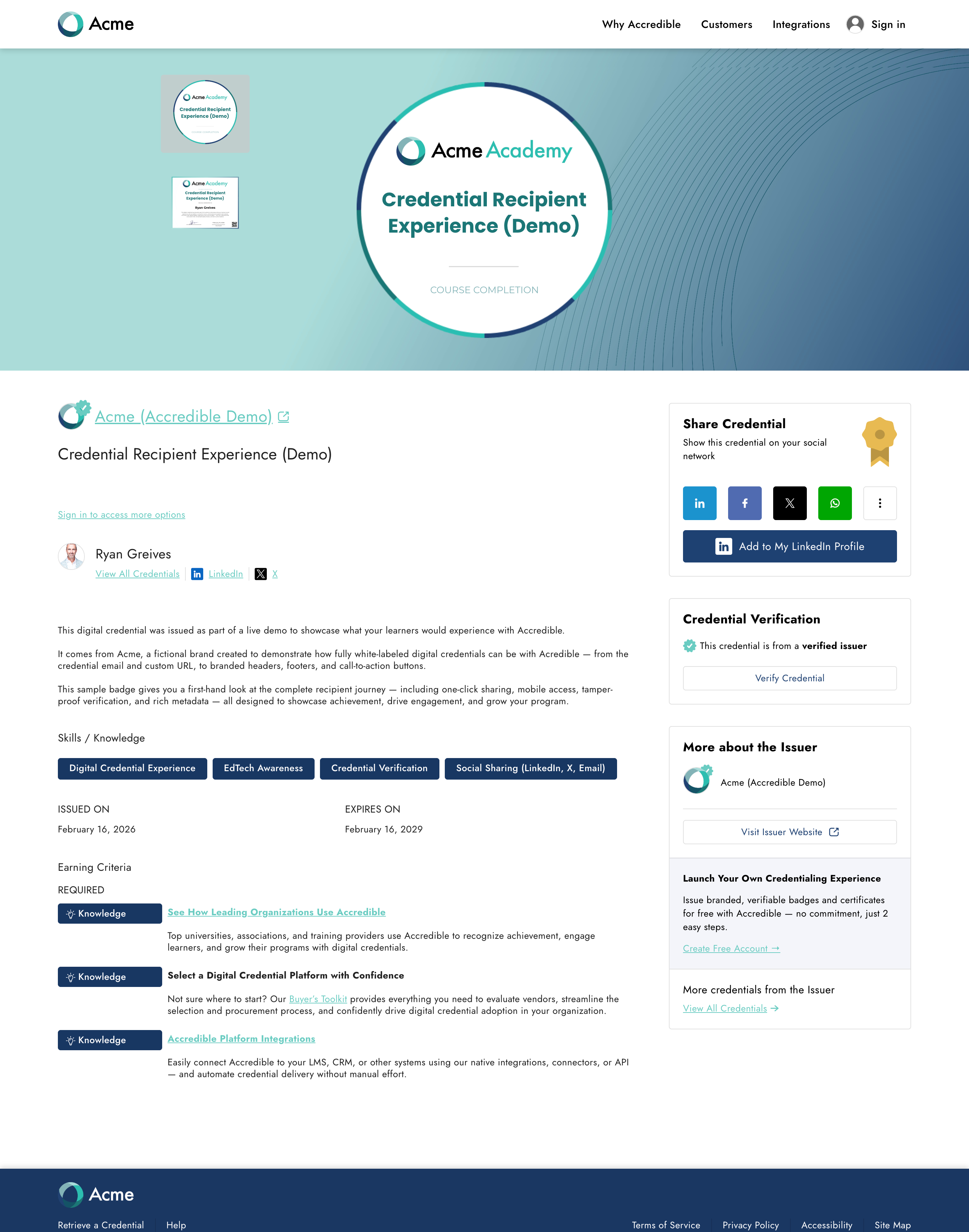
Platforms like Accredible enable organizations, including universities, professional associations, and tech companies, to issue credentials that embed this kind of detail. Learners get a shareable, verifiable record of what they know. Employers get something they can actually evaluate.
Iowa State University used Accredible to build a microcredential program across 80+ credentials in its first year, with 75% of recipients sharing their badges on LinkedIn. The students weren’t sharing because they were told to. They were sharing because the credentials were genuinely useful career signals. As one student put it: ‘It’s not just a badge, it’s the work you put into earning it that stands out.”
If you want to see what credentials with this level of detail look like for specific technical skills, or you’re building a program that issues them, Accredible’s Job Market Insights feature shows learners the roles, salaries, and live job listings connected to each credential they earn. That’s the difference between a badge and a career tool.
Make your technical skills count
Technical skills open doors. Verified technical skills keep them open.
The organizations earning the strongest outcomes from credentialing, whether they’re universities, professional associations, or tech companies running certification programs, are the ones that treat credentials as career tools, not administrative checkboxes. A credential that carries specific metadata, travels with the learner, and can be verified in seconds by an employer is doing real work.
If you’re building or running a program that teaches technical skills, the question to ask is whether your credentials are making those skills visible in a way employers can actually act on. If not, that’s the gap worth closing. See how Accredible helps organizations issue credentials that work.
Originally contributed by Lform Design. Updated and expanded by the Accredible team, May 2026.
Frequently asked questions about technical skills
What are the most in-demand technical skills right now?
According to the World Economic Forum’s Future of Jobs Report, the fastest-growing technical skills include AI and machine learning tools, data analysis, cybersecurity, cloud computing, and programming languages like Python and SQL. Within specific industries, add platform-specific skills: CRM tools in sales, marketing automation in growth roles, ERP systems in operations.
How do employers verify technical skills on a resume?
The three main methods are skill assessments (practical tests during hiring), work samples or portfolios, and digital credentials issued by a recognized third party. Digital credentials are the fastest-growing option because they’re verifiable, metadata-rich, and can be checked instantly, unlike a resume line, which requires the employer to take a candidate’s word for it.
What’s the difference between a technical skill and a soft skill?
Technical skills are specific, learnable, and measurable. They can be tested, certified, and verified. Soft skills (communication, leadership, adaptability) are broader behavioral competencies that are harder to quantify. Both matter in the workplace, but technical skills are typically easier to demonstrate and credential, which makes them more straightforward to verify in a hiring process.
What’s the difference between a digital badge and a digital certificate?
A digital badge is a graphic credential embedded with metadata: the skills assessed, the criteria to earn it, and the issuing organization. It’s designed for sharing on LinkedIn, in email signatures, and on professional profiles. A digital certificate is typically a more formal recognition of a completed course or program, closer to a traditional paper certificate but hosted digitally and verifiable by a URL. Both can carry the same metadata; the badge format is more shareable and visually distinctive.
Can a digital credential replace a degree for technical roles?
For some roles, increasingly yes. It depends on the employer and the field. Regulated professions (medicine, law, engineering in certain jurisdictions) still require formal degrees. In technology, data, and digital marketing, however, specific credentials from recognized organizations carry significant weight, particularly when they’re verifiable and paired with demonstrated work. Many employers explicitly state that relevant credentials and experience are acceptable alternatives to degree requirements.


